Thursday, July 25, 2013

Film Review-- "Burn After Reading"


How do you follow up one of the most acclaimed movies of the decade? Go batshit insane, apparently. Burn After Reading offers very little in terms of cohesion, logic, or rationality, but by plunging off the deep end, the Coens offer a sense of the absurd entropy that describes human interaction. There's a quote that goes something like "never attribute malice to what is really incompetence." To me, the biggest argument against conspiracy theories is that it's near impossible for large groups of people to coordinate and have it not be a giant disaster. In two pivotal scenes (it's hard for a scene to not be pivotal if JK Simons is in it), Burn After Reading, two high-up CIA officials admit they don't know what's going on and that they haven't learned anything from their experiences. It's a hard pill to swallow-- we search for meaning in things, how we can improve, but sometimes we can't. Burn After Reading accepts that, and although its portrayals of idiots and violence can be alienating, the absurdism of the various characters concoct a farce that hits melancholy.

The plot starts out simple enough, but convolutes in typical Coen fashion. Osborne Cox (John Malkovich) quits his job as a CIA analyst. His wife Katie (Tilda Swinton) wants a divorce, and when a personal CD with his financial records is found by gym employees Chad (Brad Pitt, who steals the film as an arrogant airhead) and Linda (Frances McDormand, fantastic as always), they assume it's top secret information. They try to extort Cox, hoping to get money for Linda's cosmetic surgeries. In all of this, Katie has an affair with Harry Pfarrer (George Clooney, who's both charming and crazy), a paranoid Treasury employee who thinks he's being followed at every turn. As characters get mixed up and turned around, the plot culminates in violence. This is what I think turned people off to Burn After Reading-- in what starts out as such a silly film, the contrast is too alienating. To me, it was a testament to the immediacy of guns and emotion-- things are done very quickly that can never be undone. All of the characters have a tremendous lack of foresight, and it all comes out to bite them in the ass. This is hard to pull off, but Burn After Reading manages to do it without making the viewer feel they've wasted their time.

While the action and emotion do fall flat occasionally-- particularly towards the beginning-- Burn After Reading never fails to entertain, and it such a silly movie, that's all I can really ask for.

Final Grade: B+


Tuesday, July 16, 2013

I watched the first two episodes of Deadwood


I'm going to do this a little differently. I'm going to talk about the first two episodes together, instead of individually. I'm also going to try out a more casual, relaxed tone. We'll see how it goes.

I wanted to watch Deadwood for two reasons: I absolutely love Westerns and it is Todd VanDerWerff's favorite show ever. With those two strong impetuses, I dived in. My first impression was that it was very, very HBO (and that's a huge compliment). The show wastes no time with unnecessary exposition or character introduction. For a small town, things move very quickly, and it requires the viewer to be attentive. I was lulled into a false sense of security, as the last HBO show I watched was Game of Thrones, and I was already familiar with the characters from reading the books. Deadwood humbled me right from the get-go, but the more I paid attention, the more I got out of the show (imagine that). The second thing I thought was "damn, this show is well-acted." It wasn't overly flashy, and when it did require sharp outbursts of emotion, they didn't seem as if they were pandering for an Emmy. The first two episodes were so explosive. It's to be expected in a land without law. I was impressed on how the various characters kept each other in check. Swearagen is obviously the kingpin of the town, but he feels threatened by Hickock, especially when his schemes start to unravel. I particularly enjoyed Seth Bollock with his quiet demeanor.

That paragraph is very sporadic, and that's how I felt watching the show. It's a lot to take in, especially with hour-long episodes, and the small bits and pieces that I was able to capture felt so right for the show that I was able to understand the parts I didn't get, a la Troy Barnes. There are a lot of characters, and it doesn't help that a lot of them have identical facial hair. Maybe it's just that all white people look alike to me (I am white, so this is a problem).

I'll have to rewatch to have a more coherent post. I'll say this: it captures human nature and economic wants very well. I'm excited to continue.

Monday, July 8, 2013

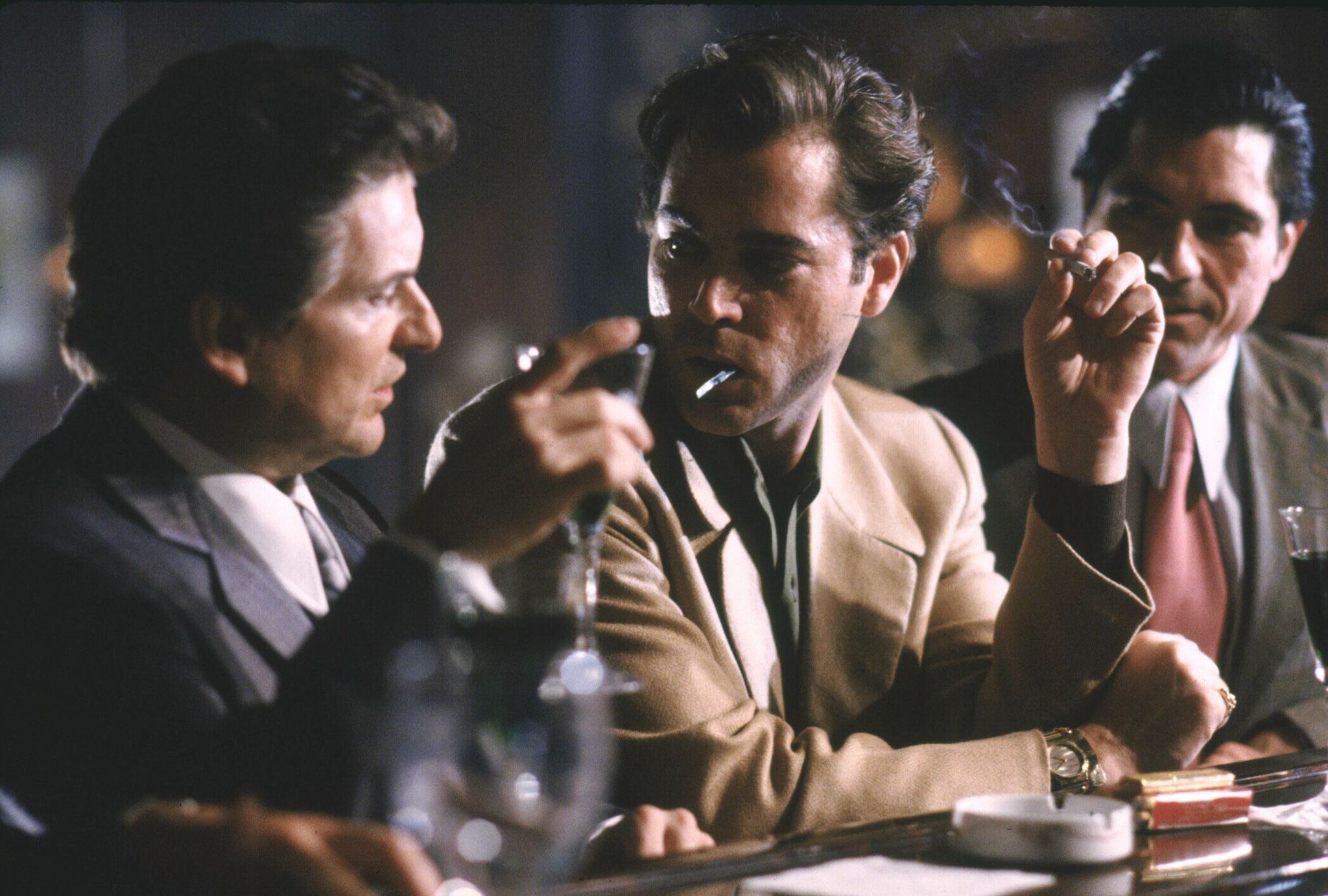
Review-- "Goodfellas"


"As far back as I can remember, I always wanted to be a gangster."

Leave it to Scorsese to start off a crime epic on a child's dream. Among the uncountable things that make Goodfellas (in my opinion) the finest film of the 90s (and possibly ever), it's a man's journey into his dream, a man getting everything he ever wanted, and what he does with it when he gets it. It's nothing new to film, but Scorsese pulls out all the stops to ensure that Goodfellas leaves an indelible impression on every viewer. It's been about 24 hours since I watched it, but I just can't get it out of my head. The voiceovers, the music, the still images, the long camera shots-- Scorsese is a technical master, but it's never showy. If anything, the camera magic is overshadowed by the fiery dialogue, or the narration that could have taken a serious misstep in so many places, but only ever adds to the turbulence of the film's main relationship, or the actors bringing something that only Scorsese seems to provide.

My thoughts on Goodfellas feel like the cocaine-aided bender at the end of the film. Sure, it's easy to say that it's a synecdote of America, the greatest crime film ever made, or any other classification. It's a thousand things at once, but it never feels forced. I was reminded of a quote from Game of Thrones: "Any man who must say 'I am the king' is no true king." Any film that has to remind its audience that its important is going to suffer. Goodfellas, in all its different themes and segments, never has to tell us that it's a great film. It tells its story and that's it.

That's not to say it isn't bold (any film that has a character break the fourth wall isn't playing it safe). There are so many techniques (I've already listed several) that could have broken the film through gimmick, but they all enhance the story, make it more real as they stop to meditate. I couldn't help but thinking about Pulp Fiction (one of the few films that rivals Goodfellas for me) and how its visual flourishes made the film, for the lack of a better word, cool. The square Uma Thurman draws with her finger, Bruce Willis with a machete, it's all stylized for the sake of style. It adds to the film, of course, but Tarantino is trying to make the film iconic (and he wildly, wildly succeeds). While it seems like this contradicts what I said earlier about films trying to seem great, Tarantino pulls it off through bombast and self-parody. Goodfellas is an intensified reality, while Pulp Fiction is an absurdist one. 

That may be the strongest part of Goodfellas: it feels real. I'm reminded of the scene in the Copacabana where Henry is given everything on a silver platter, and Karen asks "what do you do?" It seems illogical that a 21 year old could achieve that level of clout. Karen hasn't entered that world yet, but we have, and her outsider perspective as a Jewish girl shows how strange the gangster life is. Goodfellas constantly challenges us by showing how relateable and empathetic these characters can be and then contrasting that by showing the vicious  thing that they do. Anger, guilt, and lust all backdropped by mafia hits and theft create a savage America that somehow is real. The morality and guilt at the core of Henry Hill remind me of Breaking Bad, as a character dives deep into the rabbit hole of crime and looses his humanity. Without giving away the ending, its impact surprised me. It wasn't what I thought would happen, but it perfectly bookends the Henry's ambitions, rise, and fall. It walks the two sides of morality with acumen that's rarely seen. 

I'm failing to find more words, more that can be said about this movie. I've never been so impressed in so many different ways. I haven't touched on any of the characters besides Henry and Karen, or the 30 year narrative that encapsulates the mafia life. I haven't talked about the improvised dialogue that adds so much flavor. Simply, it's a brutal, intense picture of America that will shake you. It won't leave you alone, and it shouldn't. 

Final Grade: A+


Friday, June 28, 2013

Review: "Pan's Labyrinth"


Fairy tales evoke a pure sense of wonder that few other mediums can. I've found them to be immensely interesting: the creatures, setting, and overall imagination show few bounds, but systems of morality and restrictions run through them, usually to teach the protagonist a lesson or prove some allegorical point. Pan's Labyrinth manages to keep a steady sense of the marvels of childhood, while also maintaining a constant horror that comes both through its fantastical elements and its post-Spanish Civil War setting. As the stories merge together, the cohesion of reality with fantasy create a beautiful story that doesn't shy away from the terrors of war, in actual and fantastical terms. Ofelia, a young girl obsessed with cuentos de hada (I watched without subtitles) and her mother retreat to a forest camp to live with Ofelia's stepfather. El Capitán is a harsh and brutal man. He represents the Franco regime as they smoke out the rebels in the surrounding woods. Ofelia's mother struggles with a difficult pregnancy. In the midst of transition, Ofelia searches for solace in stories, and is quickly discovered by a faun, who tells her that she is the princess of a long-lost kingdom, and that she must pass three trials to claim her throne. It's a well-run trope, but the scary imagery and sense of intimate wonder allow for these trials to be among the most captivating moments of the film. As the violence of the fairy tale parallels that of the war, the film hits heavily emotional veins as families are separated and the horror of authoritarian idealism brutalizes anything that deviates. The reality of Ofelia's experiences is presented in a way that allows for multiple interpretations, and the different personalities of the adults are refined as they interact more and more with Ofelia's world.

Guillermo Del Toro gives terrifying imagination to a fantasy world that's lost all innocence. The faun that acts as a gateway for Ofelia is at turns avuncular and menacing. In the film's most chilling sequence, The Pale Man sits, eyes on a plate, waiting. The paintings of him eating children that adorn the walls, the meticulous banquet, the panicked fairies-- it's easily one of the most tense scenes I've seen in a film. The movie meanders for its first hour, allowing the pieces to fall into place. It relies on the personalities of the characters to drive the story, and it excels. The relationship between Ofelia and her mother is tender and tense, and the addition of Captain Vidal to the family dynamic allows for the horrors of the unbending idealist to be manifest in a quieter way.

The relationship between Mercedes and her rebel brother adds to the immersion of the film. The Spanish Civil War was ideology vs. ideology. As an American with some knowledge of my country's own civil war, the separation of so many families due to differences in political beliefs, the tearing apart of so many towns and cities, makes ours look calm, as only a geographical line divided the carnage there. The nebulous nature of security in the Nationalist camp adds to the need for escape. The rebels, although painted as the good guys retrospectively, are shown to be just as cruelly efficient as the army. Ofelia's world of escape grows more and more dark as the fighting and subterfuge progresses, and her loss of innocence is heartbreaking. Pan's Labyrinth finds the beauty in death, the horror in escape, the love in war. Its allegory and imagination culminate in a chilling movie that connects us to a childhood lost in war.

Final Grade: A

Wednesday, June 26, 2013

My brain is a scary place

I don’t normally remember my dreams. The ones that I do remember are usually pretty nonsensical, so I don’t put any importance in their content. Last night, however, was a dream that I’ll always remember.

The world was grey, monotone. It felt like a filter in a post-apocalyptic movie. Life seemed to move on as it always had, but there was no heart, no soul. Everything was robotic and joyless. I looked into people’s eyes and saw nothing. I was a voyeur, floating through crowds, looking for life and love, but I couldn’t find it. People were slaves to their jobs, the system that only wanted their hands and skills to augment the bourgeois wallet.

The saddest thing was that no one was speaking. I tried to engage with the people, to find out what the hell had happened, but they all seemed incapable or unwilling. I must have had some omniscient powers, because I found out that all artists had somehow been silenced. The ability to create, to speak out was gone. This world was hell, and there was no way to fix it. But, as I learned, there was one rebel. One voice of hope. A man who was not silent, who let his art, his craft defy the oppressors at every turn, a symbol of what it meant to be human, of what it meant to live, to love, to fight. In the monotone Hades, he was a Messiah, a hero, what we needed to retake our humanity.

This man was 2 Chainz.

I didn’t know how he had retained his voice in such oppressive times. He hadn’t faded, instead, he had somehow grown. In the dead quiet of the city streets, without warning, a primal yell would burst from the shadows. It was only his name, It sounded like this, and it was beautiful. He had retained his identity in a system that aimed to eliminate it. In a world where people were unable to pronounce their names, he yelled it through some unknown power, a pariah to the faceless oppressor, but to those suffering, a savior.

I don’t know what this means. Is 2 Chainz the hero I dreamt he was? In a world with NSA, IRS, and every kind of acronym-ridden scandals, with all types of hyperbole and machinations, something so complicated we can’t understand, he has said:

“She has a big booty, so I call her big booty.”

When the day comes that democracy fails, when all hope is lost, I hope that we have a hero, a 2 Chainz. This is what we need, what we want. All I want for my birthday is a hero.   

Monday, June 24, 2013

Film Review-- "The Master"


Family is something that's explored again and again in art. It's how we come into and experience the world, so it seems like it should be easy to understand, but it's not, and through all of our attempts to decipher what it means to be family, and as the definition of family expands, the concept gets less and less cut and dry. The myriad relationships are all fascinating, but there's something about the bond between a father and a son that spawns story upon story. The Master elevates this relationship into maddening greatness, a sprawling tale that refuses to offer easy resolution or sterile symbolism. The interactions between Joaquin Phoenix and Phillip Seymour Hoffman are some of the most tense I've ever seen, and the various role reversals and psychological manipulation add to the overwhelming uncertainty of the film. Predictability in a movie is by no means a bad thing, but post WWII America was high-stakes, and even though its day has run its course, it doesn't deserve the standard whitewashing of Hollywood. Leave it to Paul Thomas Anderson to descend into its darkness and pull out The Master.

The Master is a difficult film. It refuses to compromise its vision of a post-war America that searches for healing in the charismatic vacant places of its infrastructure. It's unsettling to watch the characters come apart at its seams, set to the brilliant score of Johnny Greenwood. Doubt, resurgence and trust lather the film with complex emotion that gives The Master a dark undercurrent. Freddie (Joaquin Phoenix) is a former sailor who is obsessed with sex and liquor. After various troubles with employment and self-control, he serendipitously boards a boat helmed by Lancaster Dodd (Phillip Seymour Hoffman), leader of the quasi-science cult The Cause. Dodd is charismatic, self-doubting, outright hostile towards anyone who questions him, and Freddie is his muse. Freddie finds fulfillment as an acolyte/brewmaster, and his devotion seemingly grows as he submits to psychological tests designed to find the root of his trauma. These scenes of pseudoscience are some of the best of the film-- the tests have to be garbage, none of them make an iota of sense, but they seem to help Freddie, at least until he attacks someone for questioning The Cause. It would have been easy to write off Dodd and his wife (the wonderful Amy Adams) as lunatics or moneylauderers, leaders of a scam, but the complexity and self-doubt the two give their roles makes it seem as if we really are eternal spirits, and that Dodd and Freddie have known each other for trillions of years. The movie has several dreamlike sequences to unearth the traumas of the past, and instead of turning the movie into a cheap metaphor, they add to the feel that all of this really could be eternal. It's a fine line between insanity and clairvoyance, but The Master takes all the right steps without playing it safe.

As mentioned before, The Master isn't a pretty Hollywood movie made to satisfy or enthrall. It's dark, challenging, and the character's motivations aren't always clear. That isn't to say that there isn't hope-- sometimes, in their quiet moments, the characters find reassurance that what they're doing is right. They're few and far between, but they add diversity to an already sprawling film. It adds to an anachronistic American dream that isn't a cheery advertisement, but what it must have been like to find the silence after a storm, even as it continues rampant in your head. America has long been trying to convince itself that it's something apart from itself, an idealized version of a deeply flawed country. In a sense, The Master reminded me of a video game held in equally high regard: Bioshock Infinite. Both rage with the conflict of reality versus a fantasy, with neither looking ideal. However, the choice must be made, and both stories flash back to reveal how the characters arrived to the choice. Where Bioshock Infinite uses violence and racism to accentuate its motifs, The Master delves into the mind of a depraved man and the incorrigible desire to reform him of a cult leader grasping at straws. Neither shy away from the darkest places America reaches. Dodd is a scary synecdote of  America: he has an easy charm and dogged determination to fix the most unfixable, but his methods are dubious, and he reacts violently to any perceived slight. Metaphor runs deep throughout The Master, but it never distracts from telling its story.

Paul Thomas Anderson shocked and unsettled us with his vision in There Will Be Blood, with its volcanic violence and greed. He adds another brushstroke to his portrait of America with The Master, a terrifying place, scattered with hope. This is not a film for the impatient, but it rewards those who dive into its world with stark portrayals of what we are.

Final Grade: A+


Sunday, June 16, 2013

Deadwood is Coming

On a related note, I will start reviewing Deadwood. I've never seen it, so this'll be interesting.