Friday, June 28, 2013
Review: "Pan's Labyrinth"
Fairy tales evoke a pure sense of wonder that few other mediums can. I've found them to be immensely interesting: the creatures, setting, and overall imagination show few bounds, but systems of morality and restrictions run through them, usually to teach the protagonist a lesson or prove some allegorical point. Pan's Labyrinth manages to keep a steady sense of the marvels of childhood, while also maintaining a constant horror that comes both through its fantastical elements and its post-Spanish Civil War setting. As the stories merge together, the cohesion of reality with fantasy create a beautiful story that doesn't shy away from the terrors of war, in actual and fantastical terms. Ofelia, a young girl obsessed with cuentos de hada (I watched without subtitles) and her mother retreat to a forest camp to live with Ofelia's stepfather. El Capitán is a harsh and brutal man. He represents the Franco regime as they smoke out the rebels in the surrounding woods. Ofelia's mother struggles with a difficult pregnancy. In the midst of transition, Ofelia searches for solace in stories, and is quickly discovered by a faun, who tells her that she is the princess of a long-lost kingdom, and that she must pass three trials to claim her throne. It's a well-run trope, but the scary imagery and sense of intimate wonder allow for these trials to be among the most captivating moments of the film. As the violence of the fairy tale parallels that of the war, the film hits heavily emotional veins as families are separated and the horror of authoritarian idealism brutalizes anything that deviates. The reality of Ofelia's experiences is presented in a way that allows for multiple interpretations, and the different personalities of the adults are refined as they interact more and more with Ofelia's world.
Guillermo Del Toro gives terrifying imagination to a fantasy world that's lost all innocence. The faun that acts as a gateway for Ofelia is at turns avuncular and menacing. In the film's most chilling sequence, The Pale Man sits, eyes on a plate, waiting. The paintings of him eating children that adorn the walls, the meticulous banquet, the panicked fairies-- it's easily one of the most tense scenes I've seen in a film. The movie meanders for its first hour, allowing the pieces to fall into place. It relies on the personalities of the characters to drive the story, and it excels. The relationship between Ofelia and her mother is tender and tense, and the addition of Captain Vidal to the family dynamic allows for the horrors of the unbending idealist to be manifest in a quieter way.
The relationship between Mercedes and her rebel brother adds to the immersion of the film. The Spanish Civil War was ideology vs. ideology. As an American with some knowledge of my country's own civil war, the separation of so many families due to differences in political beliefs, the tearing apart of so many towns and cities, makes ours look calm, as only a geographical line divided the carnage there. The nebulous nature of security in the Nationalist camp adds to the need for escape. The rebels, although painted as the good guys retrospectively, are shown to be just as cruelly efficient as the army. Ofelia's world of escape grows more and more dark as the fighting and subterfuge progresses, and her loss of innocence is heartbreaking. Pan's Labyrinth finds the beauty in death, the horror in escape, the love in war. Its allegory and imagination culminate in a chilling movie that connects us to a childhood lost in war.
Final Grade: A
Wednesday, June 26, 2013
My brain is a scary place
I don’t normally remember my dreams. The ones that I do remember are usually pretty nonsensical, so I don’t put any importance in their content. Last night, however, was a dream that I’ll always remember.
The world was grey, monotone. It felt like a filter in a post-apocalyptic movie. Life seemed to move on as it always had, but there was no heart, no soul. Everything was robotic and joyless. I looked into people’s eyes and saw nothing. I was a voyeur, floating through crowds, looking for life and love, but I couldn’t find it. People were slaves to their jobs, the system that only wanted their hands and skills to augment the bourgeois wallet.
The saddest thing was that no one was speaking. I tried to engage with the people, to find out what the hell had happened, but they all seemed incapable or unwilling. I must have had some omniscient powers, because I found out that all artists had somehow been silenced. The ability to create, to speak out was gone. This world was hell, and there was no way to fix it. But, as I learned, there was one rebel. One voice of hope. A man who was not silent, who let his art, his craft defy the oppressors at every turn, a symbol of what it meant to be human, of what it meant to live, to love, to fight. In the monotone Hades, he was a Messiah, a hero, what we needed to retake our humanity.
This man was 2 Chainz.
I didn’t know how he had retained his voice in such oppressive times. He hadn’t faded, instead, he had somehow grown. In the dead quiet of the city streets, without warning, a primal yell would burst from the shadows. It was only his name, It sounded like this, and it was beautiful. He had retained his identity in a system that aimed to eliminate it. In a world where people were unable to pronounce their names, he yelled it through some unknown power, a pariah to the faceless oppressor, but to those suffering, a savior.
I don’t know what this means. Is 2 Chainz the hero I dreamt he was? In a world with NSA, IRS, and every kind of acronym-ridden scandals, with all types of hyperbole and machinations, something so complicated we can’t understand, he has said:
“She has a big booty, so I call her big booty.”
When the day comes that democracy fails, when all hope is lost, I hope that we have a hero, a 2 Chainz. This is what we need, what we want. All I want for my birthday is a hero.
Monday, June 24, 2013
Film Review-- "The Master"
Family is something that's explored again and again in art. It's how we come into and experience the world, so it seems like it should be easy to understand, but it's not, and through all of our attempts to decipher what it means to be family, and as the definition of family expands, the concept gets less and less cut and dry. The myriad relationships are all fascinating, but there's something about the bond between a father and a son that spawns story upon story. The Master elevates this relationship into maddening greatness, a sprawling tale that refuses to offer easy resolution or sterile symbolism. The interactions between Joaquin Phoenix and Phillip Seymour Hoffman are some of the most tense I've ever seen, and the various role reversals and psychological manipulation add to the overwhelming uncertainty of the film. Predictability in a movie is by no means a bad thing, but post WWII America was high-stakes, and even though its day has run its course, it doesn't deserve the standard whitewashing of Hollywood. Leave it to Paul Thomas Anderson to descend into its darkness and pull out The Master.
The Master is a difficult film. It refuses to compromise its vision of a post-war America that searches for healing in the charismatic vacant places of its infrastructure. It's unsettling to watch the characters come apart at its seams, set to the brilliant score of Johnny Greenwood. Doubt, resurgence and trust lather the film with complex emotion that gives The Master a dark undercurrent. Freddie (Joaquin Phoenix) is a former sailor who is obsessed with sex and liquor. After various troubles with employment and self-control, he serendipitously boards a boat helmed by Lancaster Dodd (Phillip Seymour Hoffman), leader of the quasi-science cult The Cause. Dodd is charismatic, self-doubting, outright hostile towards anyone who questions him, and Freddie is his muse. Freddie finds fulfillment as an acolyte/brewmaster, and his devotion seemingly grows as he submits to psychological tests designed to find the root of his trauma. These scenes of pseudoscience are some of the best of the film-- the tests have to be garbage, none of them make an iota of sense, but they seem to help Freddie, at least until he attacks someone for questioning The Cause. It would have been easy to write off Dodd and his wife (the wonderful Amy Adams) as lunatics or moneylauderers, leaders of a scam, but the complexity and self-doubt the two give their roles makes it seem as if we really are eternal spirits, and that Dodd and Freddie have known each other for trillions of years. The movie has several dreamlike sequences to unearth the traumas of the past, and instead of turning the movie into a cheap metaphor, they add to the feel that all of this really could be eternal. It's a fine line between insanity and clairvoyance, but The Master takes all the right steps without playing it safe.
As mentioned before, The Master isn't a pretty Hollywood movie made to satisfy or enthrall. It's dark, challenging, and the character's motivations aren't always clear. That isn't to say that there isn't hope-- sometimes, in their quiet moments, the characters find reassurance that what they're doing is right. They're few and far between, but they add diversity to an already sprawling film. It adds to an anachronistic American dream that isn't a cheery advertisement, but what it must have been like to find the silence after a storm, even as it continues rampant in your head. America has long been trying to convince itself that it's something apart from itself, an idealized version of a deeply flawed country. In a sense, The Master reminded me of a video game held in equally high regard: Bioshock Infinite. Both rage with the conflict of reality versus a fantasy, with neither looking ideal. However, the choice must be made, and both stories flash back to reveal how the characters arrived to the choice. Where Bioshock Infinite uses violence and racism to accentuate its motifs, The Master delves into the mind of a depraved man and the incorrigible desire to reform him of a cult leader grasping at straws. Neither shy away from the darkest places America reaches. Dodd is a scary synecdote of America: he has an easy charm and dogged determination to fix the most unfixable, but his methods are dubious, and he reacts violently to any perceived slight. Metaphor runs deep throughout The Master, but it never distracts from telling its story.
Paul Thomas Anderson shocked and unsettled us with his vision in There Will Be Blood, with its volcanic violence and greed. He adds another brushstroke to his portrait of America with The Master, a terrifying place, scattered with hope. This is not a film for the impatient, but it rewards those who dive into its world with stark portrayals of what we are.
Final Grade: A+
Sunday, June 16, 2013
Deadwood is Coming
On a related note, I will start reviewing Deadwood. I've never seen it, so this'll be interesting.
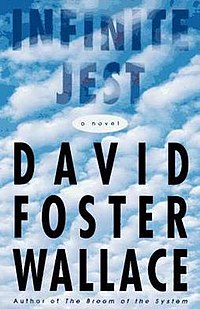
The Great Undertaking of 2013
Postmodern literature is my favorite literature. It's difficult, frustrating, demeaning, and I feel like a masochist for reading it. I read both Ulysses and Gravity's Rainbow in high school. I got two of the big three. I had heard of Infinite Jest, but it really hadn't registered that I should read it.
Now that I'm working on my own novel, I want to have the three under my belt in order to make the book as good as it can be. I'll post periodic updates on my reading of Infinite Jest, and there will be a lengthy review/essay at the end. This should be fun!
Saturday, June 15, 2013
Review-- "Children of Men"
I watch movies to feel things. I'd like to imagine that most people do, too. Whether it be laughter, vindication, empathy, it's all catharsis. Sure, movies can have grandiose schemes of philosophical concepts that chalk up victory points with whatever the creator's point was. I like to be intellectually stimulated by film. But when it comes down to it, there's a certain magic to seeing people live out a story, and especially one where we see parts of ourselves. It's a distinctly human form of storytelling. We react to what we see, and emotions pour out, visceral and beautiful and haunting and whatever else they need to be.
This visual intimacy is why Children of Men is the astounding piece of art that it is. Alfonso Cuarón lets the camera linger. It follows, almost seeks, the action in a devastating plunge into hope and despair. It's a fairly complex film, with themes of xenophobia, authoritarianism, and moral relativity, and it sounds cliche, but the characters and their motivations are the driving force of the film. Cuarón misses none of this. His camera sits and stays and absorbs all the drama the film has to offer. It's a simple premise-- in a dystopian future, society in almost all the world has collapsed due to infertility. The opening scene shows the film will pull no punches. It's brutal and unforgiving in its depiction of human suffering and cruelty, but it's not cynical-- characters do good, help each other. In a memorable soliloquy by Jasper (the never-better Michael Caine), fate and chance bring us together and tear us apart, but we can't know exactly what or why, but dammit, why not just enjoy those fleeting moments? Theo (Clive Owen) has had that hope ripped away from him, and the realism of the film and his character add an onerous pathos that can't be ignored. The camera settles on him more often than not, and he delivers on every note.
The film feels real. I've seen more apocalyptic films than I care to admit, and I didn't know how Children of Men was going to shiny up the tired formula. It didn't go for the bombastic or overly gritty. It made it real, almost a mirror, and that's the most terrifying part of the film. We could someday ban all immigrants. It seems far-fetched for many nations at this point, but if some catastrophic event happens? What then? The various religious and political groups, in their uncompromising ideologies, feel extreme, but that's what they've been pushed to. This is life pushed to hysteria, the breaking point. It feels barren, but never loses the edge of rebellion and hope. I had no idea what resolution would be reached, if any, but the balance of faith and despair drives the film, and I couldn't help but follow it as it delves into the worlds of ghettos, the fanciful rich, and every other abscess of humanity.
Art compromises to please the viewer. It happens, and with varying levels of sycophancy, it detracts. I'm not saying that an action romp or a raunchy comedy are worse than arthouse-- if a script has a vision, it should stick to that vision, and the audience should take it as is. Children of Men is as uncompromising a film as I've seen. It's alternatively dark and hopeful, but the one doesn't act as a salve to the other. It's startlingly natural in a world that isn't. This is a film that deserves a 2nd and 3rd and 4th viewing. I haven't said nearly as much as I would like to say, and I'm sure that I'll say more. This film is a masterpiece, and from the 2000s, only No Country for Old Men and There Will Be Blood best it. A wonder of a film.
Final Grade: A+
Thursday, June 13, 2013
Wake up Mr. West-- Why modern music (and art) desperately need Kanye
When it comes to divisiveness, no one does it better than Ye. Myriad events have cemented him as one of the most controversial figures in pop culture-- dressing up as Jesus for Rolling Stone didn't do it for him, so he had to malign the speech of a universally loved pop princess, say the POTUS is racist, and generally let his ego get the best of him. The mainstream media dismisses him as an egomaniac who's talking to a fanbase that isn't there, the general public mocks him, and South Park calls him a gay fish (I haven't seen the episode, so this makes no sense to me, other than showing how puerile and homophobic South Park can be). Why hasn't Ye been discarded, relegated to playing in casinos and dive bars?
Listen to his music. Really listen to it. Go deeper than "Gold Digger" and "Stronger" (even though both are fantastic songs). Listen to his albums in chronological order. Read and watch some interviews of him. Let the man speak for himself, let him explain his flaws and shortcomings. Think he's not aware of who he is? Listen to "Runaway" or "Family Business", and why Ye is Ye will explain itself. At this point in his career, he's looking to be the greatest artist of his generation, and he's only 36. That's to say nothing of his producing some of the best hip hop albums and songs ever. He's committed, and if that makes him an asshole, he's an ingenious, necessary, bombastically incredible asshole.
Through his long and fruitful career, that's been his savior and demon-- he's committed, dammit, and it gets him in trouble, but his immersion in his craft has created the best music that the 21st Century has to offer. In this interview with the New York Times, Ye explains that his mentality is that of greatness-- he doesn't have time to waste believing that he's anything else than the apex of the rap game, and culture, and fashion, and whatever he puts his mind to. That integrity eschews marketability, lowest common denominator content, or any other obstacle in his single-minded quest for the best music he can make. The fashion questions and answers of the interview particularly intrigued me--artists, particularly those in pop music, work to cultivate an image through what they wear, but the dedication that Kanye puts towards his look transcends mere aesthetics-- it goes to a lump sum of x's and y's that add up to an icon. He spares no detail, no minutiae that walk the line between greatness and near religious experiences for the listener. He talks about being inspired by a lamp. If any other musical artist said that, I would scoff. How the hell can they be inspired by a lamp? But said by Kanye, it somehow works. Everything is pushed through a filter that results in things like "My Beautiful Dark Twisted Fantasy." I remember when Kanye got a Twitter account, and the tweets he sent out were mostly about the troubles of finding rare luxury items. People laughed and mocked. Here's the thing, though-- they were paying attention. Newspapers were writing articles about his tweets. Now there's room to criticize the media, but there's not room for that here. Why would Kanye make such outrageous statements? Even as a fan, some of them were out there. He sent them out while making MBDTF, an album that deals heavily with the nature of fame. It starts off lauding what he's done, before everything falls apart, and he's left with nothing but his ego. He had to get in the zone, and if being humiliated by internet lowlifes was the price, he was more than willing to pay.
It's clear that Kanye doesn't have a comfort zone. I've listened to other artists (it's not my place to criticize here, so no names) who get lazy after some time in the game. They put out records that aren't necessarily bad, and I've enjoyed them, they just play it safe. They have a formula to success, and they stick with it. I don't see this as a negative, as I often enjoy these albums. There's always a nag, though. They could be doing more with their talent, they could be growing, but they're not, and it frustrates me (whether or not it should, once again, is another question for a different day). Kanye lives on the edge of the knife in this regard. All 5 of his solo albums differ greatly. People thought he had taken a serious misstep with 808's and Heartbreak. It was so different from the rest of his music. And he was singing! He wasn't very good at it! I had been a fan of him at that point, and this baffled me. I liked the album, but it didn't connect with me the same way his previous work had done. However, looking back in a non-Autotune dominated era, I see how important the album is. It allowed for hip hop to be more introspective and moody than it ever had been before. It's difficult to see Drake or Frank Ocean come to such prominence without the stepping stone of 808s. In a lot of ways, this album did for hip hop what Bob Dylan did for pop music-- it allowed for new subject matter to be explored in existing formulas.
This is why Kanye matters. He's the first one to put his foot in the water and see if it'll work or not. He's dedicated himself to his art, and to being the best, and even when he suffers, he allows it to create beautiful things. There are great artists who play by the rules, and they succeed. Then comes a Picasso, a Dylan, a Kanye, who knows the rules so well, and can play by them just as well, and decides to deconstruct it all. This isn't a 9 to 5 arrangement, this is jumping off the cliff. Kanye does what's needed for his art. He's an ideologue, not a pragmatist, and when people hate him for it, he makes their catcalls his theme song. It's so much more than "fuck what the world thinks", though, he's too self aware for that to be the case. he accepts what he is at the moment, makes what he needs, and moves on. He's transcended being a pop star. He's an icon, despised, adored, idolized, and we need that. There seems to be a camaraderie between artists today, patting each other on the back, saying "damn, we're special, aren't we?" They make good, not overly challenging music, then Kanye comes along and switches up the formula while cranking it to eleven. While he doesn't always succeed (and even he'll admit that he's fallible), he's a catalyst for a whole genre of music. Who else can get away with broadcasting his new song on the sides of billboards? Who else can say "I'm not playing my music on the radio anymore" and have it work? Only Ye. He's shooting us into the unknown, and we can't help but enjoy the ride.
And when it comes to his ego, well, the man says it best: "it's hard to be humble when you're stunting on a Jumbotron."
Here's to the 18th, Kanye. Amaze us once again.
Subscribe to:
Posts (Atom)